Design for Manufacturing: 5 Ways to Reduce Turned Part Costs Before Serial Production
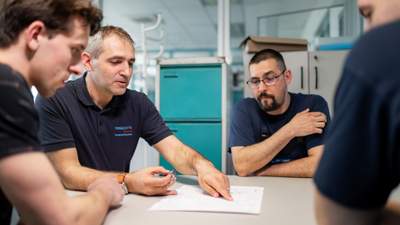
In the procurement of precision turned parts, cost pressure is high. Often, a finished drawing is sent to multiple suppliers with the expectation of receiving the most economical offer. However, the greatest potential for savings usually doesn't lie in a pure price comparison, but in a much earlier phase: in the collaborative dialogue between design engineers, procurement, and manufacturing experts.
This is precisely where the "Design for Manufacturing" (DfM) concept comes in. The goal is to design a component from the very beginning to be optimally suited for serial production. The earlier your experts look at a component with us, the better we can align technical requirements with manufacturing effort. We at mesa parts will show you five areas where this exchange is particularly worthwhile.
1. Understanding the Assembly: Looking Beyond Just a Single Turned Part
Frequently, as a manufacturing partner, we receive a drawing, material specifications, and a quantity. What's often missing is the context: What function will the component perform later? In which assembly will it be installed? However, understanding the end-use application is crucial for unlocking potential. When we know not just the drawing but also the final installation, we can provide targeted advice on whether, for example, tolerances in non-critical areas can be loosened or if functions can be sensibly distributed across multiple components. This makes the manufacturing of turned parts simpler and more economical without compromising function.
2. Questioning Material Specifications: Strategically Controlling Costs in Turned Part Manufacturing
Material selection has a direct impact on manufacturing costs. Availability, machinability, and tool life differ significantly depending on the material. Although materials are often specified for good reasons, it's still worth asking if alternatives are conceivable. An open dialogue about possible materials can often reveal more economical solutions that fully meet the component's functional requirements. As an expert company for turned parts, we see it as our duty to proactively advise you here and jointly find the best balance between function and cost.
3. Defining Turned Part Precision: Clearly Communicating Critical Tolerances
A common misunderstanding: For a manufacturer, every tolerance on the drawing is initially considered equally important and must be achieved with high effort and process reliability. In practice, however, there are usually only a few truly function-critical dimensions. If these requirements are communicated transparently and clearly marked on the drawing, we can specifically design the manufacturing and inspection processes around them. The goal is not to reduce quality, but to ensure the required turned part precision exactly where it is indispensable for the function. This avoids unnecessary effort and creates security.
4. Optimizing Geometry: Big Impact Through Small Adjustments
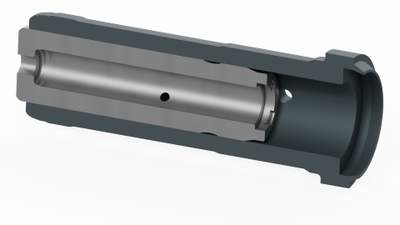
Small geometric adjustments can have enormous effects on manufacturing costs. Unfavorable drilling angles, complex undercuts, or special radii often require expensive custom tools and additional work steps. Frequently, such details can be designed with minimal changes to allow for the use of standard tooling. The prerequisite for this is that we discuss potential degrees of freedom early on. A brief technical exchange is often enough to avoid unnecessary custom solutions and increase the profitability of the entire series.
5. Conclusion: Dialogue as the Key – Why an Expert Company for Turned Parts Makes the Difference
The most economical solution for turned parts is rarely created at the CAD workstation alone. It is created where the know-how of your design, procurement, and assembly teams meets the manufacturing competence of an experienced partner. Since 1896, mesa parts has been manufacturing precision turned parts and uses this experience to advise clients as a partner on equal footing.
The more background information you share during the quoting process, the more targeted we can be in our search for optimizations. For mesa parts, Design for Manufacturing means talking together about the best solution at an early stage.
Start the dialogue and optimize the costs of your next series. Our experts look forward to your inquiry.

 Precision Turned Parts: From Watchmaking to High-Pressure Technology