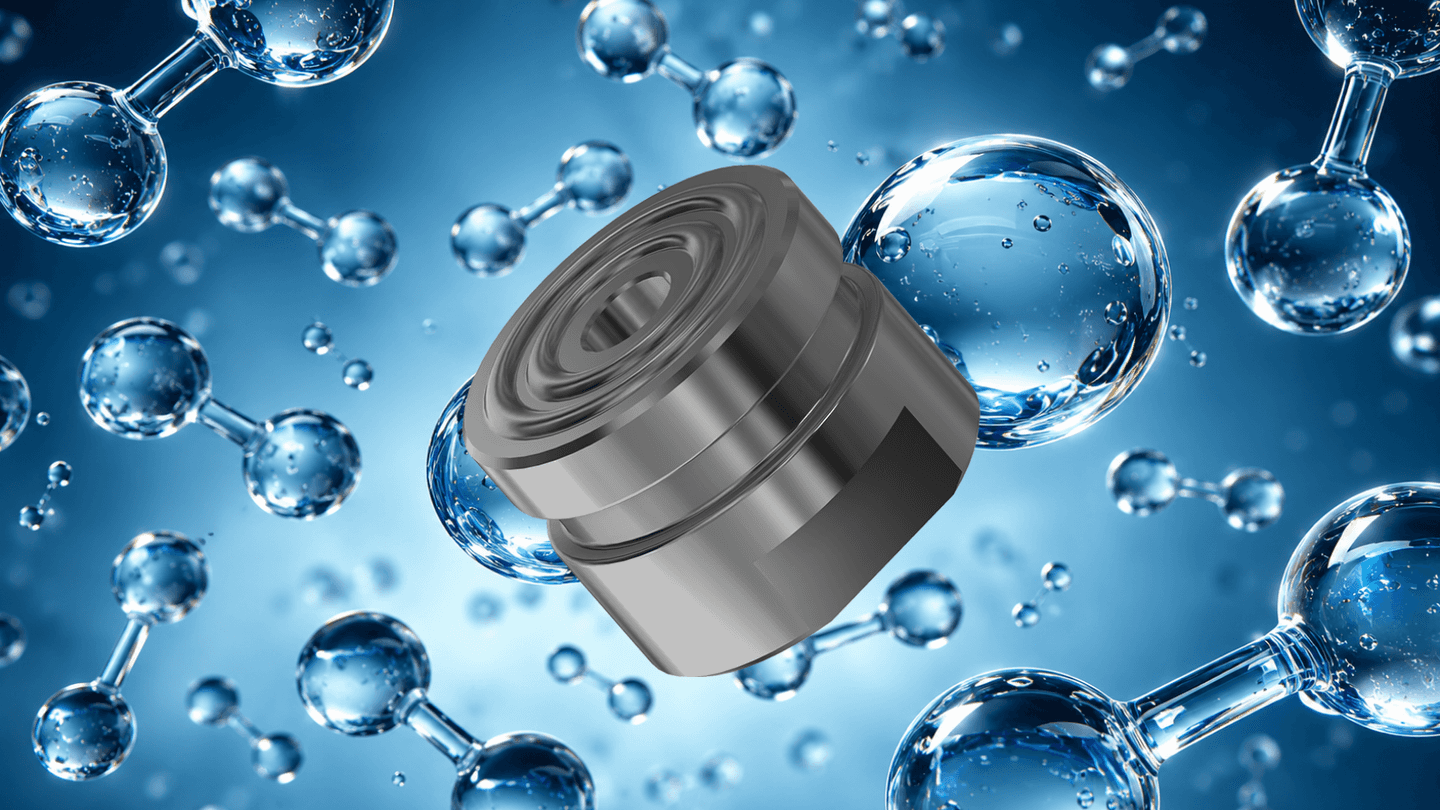
Hydrogen places specific demands on components and manufacturing processes. Particularly in applications where gases are conveyed, regulated or reliably sealed under high pressure, every detail matters.
For precision-turned parts, this means that tight tolerances alone do not determine component performance. Material, geometry, surface finish and manufacturing method must all be precisely matched to the intended application. This is particularly important for sealing and functional surfaces, where even the machining method can make a decisive difference.
Suitable Materials for Hydrogen Applications: Demanding in Both Use and Machining
Depending on the application and customer specifications, various materials may be suitable for hydrogen components. These include austenitic stainless steels such as 1.4435 and 1.4571, ferritic stainless steel such as 1.4016, and suitable aluminium alloys such as 3.3211.
Material selection influences not only the properties of the finished component but also its machinability. Cutting parameters and manufacturing strategies must therefore be adapted to the material, geometry and required surface quality.
Especially in series production, the challenge is not simply to manufacture a complex geometry once. The key is to ensure that the required properties can be achieved consistently and reproducibly across large production volumes.
Sealing Surfaces in Hydrogen Applications: Why "Smoother" Is Not Always Better
The sealing surfaces of a component require particular attention. A good sealing surface cannot simply be defined by achieving the lowest possible surface roughness.
Different functions may require different surface characteristics. A static sealing surface has different requirements from a dynamic seal or a guide surface. Accordingly, different surface parameters such as Rz, Rpk, Rvk, Pt, Wt or RMr may be relevant for evaluation.
Even more important is the actual surface structure. Turning, for example, can create a characteristic helical pattern. Such a surface may achieve very low roughness values while still presenting a potential leakage path along this structure. Consequently, two surfaces with comparable conventional roughness values are not necessarily functionally equivalent.
For gas-tight components, what matters is therefore not just how rough or smooth a surface is, but also how it was produced and what structure was created in the process.
Sealing Solutions for Hydrogen Applications: How the Machining Process Affects Leak Tightness
Various processes are available for manufacturing functional and sealing surfaces, including turning, fine turning, burnishing and additional finishing processes. The most suitable method depends on the function of the respective surface.
Leakage tests on corresponding functional surfaces demonstrate the practical impact of this decision. For example, turned and burnished surfaces on an internal cone made from 1.4016 were compared under identical conditions. In tests using 100% helium at 20 °C and 7 bara, burnished components showed approximately 10% less leakage than turned components. An additional finishing step was able to reduce the leakage rate even further.
This example illustrates why the machining of a sealing surface should not be evaluated solely against a specified roughness value. The component's intended function must already be considered when defining the manufacturing process.
Hydrogen Applications: Precision Down to the Smallest Geometries
In addition to demanding sealing surfaces, hydrogen components may also require highly delicate geometries, such as extremely small bores. These structures place particular demands on tooling, process control and reproducibility.
At mesa parts, for example, bores with a diameter of just 0.15 mm have already been industrialised for a series-produced component. Bores of similarly small dimensions can also be manufactured in materials used for hydrogen applications.
This is where the difference between technical feasibility and a reliable series production process becomes clear: the decisive factor is not a single successfully manufactured component, but the ability to reproduce the result consistently over time.
Cleaning Sealing Surfaces: Cleanliness Is Part of the Process
In addition to material, geometry and surface quality, cleanliness also plays an important role in demanding gas-carrying components. Technical cleanliness should not be considered only at the end of the manufacturing process. The relevant requirements should already be taken into account during process planning. The necessary cleaning, inspection and packaging procedures depend on the component, its intended function and customer-specific requirements.
Accordingly, the manufacturing process does not end with the final machining operation. Subsequent steps such as inspection, assembly and packaging may also form part of a manufacturing solution tailored to the application.
The Key Is How Everything Works Together: Turned Parts for Hydrogen High-Pressure Applications
There is no single factor that determines the quality of precision-turned parts for hydrogen high-pressure applications. Material, component geometry, sealing surfaces, surface structure and manufacturing processes all interact directly. A low roughness value alone does not guarantee an optimal sealing surface. Equally, selecting a suitable material is not enough if the machining process is not adapted to its intended function.
That is why manufacturing considerations should be incorporated early in component development: What function must a surface perform? What surface structure is required? Which process can produce it reliably? And how can the process subsequently be transferred to series production in a stable and reproducible way?
This is where the strength of design for manufacturability lies: not in optimising individual characteristics in isolation, but in translating the requirements into a reliable, production-ready overall process.
If you are planning a hydrogen project, get in touch with us. Your personal contact at mesa parts will discuss your drawing and requirements with you.

 IATF 16949 Explained: What the Automotive Standard Means for the Quality of Your Turned Parts